Tuesday, October 18, 2016

History of Cars - Car Planet

Chariots thrived in the ancient Mediterranean and Middle-East. Steam-power was a product of 18th-century Britain. In the 19th century, French and German engineers built the first gasoline cars. At the start of the 20th century Henry Ford, an American, made simple cars people could afford. Ever since then, the miracle of the motor car has spread around the world... and changed the face of our planet.

People's wagon: 1940s: Germany

German dictator Adolf Hitler (1889–1945) gave Henry Ford a medal for making cars affordable. Inspired by the Model-T Ford, Hitler asked German auto-maker Dr Ferdinard Porsche to develop a simple people's car or "Volks Wagen" called the KDF (Kraft durch Freude or Strength through Joy). Renamed the Beetle, it sold over 20 million worldwide and was one of the most popular cars of the 20th century.
A 1960s Austin Mini
Photo: Small, basic cars like this Austin Mini, popular in the UK during the 1960s and 1970s, owed much to pioneering, affordable cars like the Model T-Ford and Volkswagen Beetle.

Status symbols: 1950s–1960s: America

Ford wanted to keep cars simple to keep them cheap. But his "any color so long as it's black" message fell out of favor: people wanted comfort and style. In the 1930s, cars became sleek, glamorous, and "streamlined"; inside, they boasted luxuries like automatic gears and window defrosters. The end of World War II brought cars inspired by planes. Swaggering "gas guzzlers" were given tail fins like jet fighters—and burned almost as much fuel!

Paving the way: 1930s–1950s: Europe and America

Many countries launched huge roadbuilding schemes in the mid-20th century. Hitler helped to pioneer Germany's high-speed Autobahns in the 1930s, while his Italian pal Benito Mussolini (1883–1945) greatly expanded the Italian network of autostrade. Britain didn't start building motorways until the 1950s, when America also reorganized its major roads into a simple numbered network called the Interstate Highway System.

Cuban Classics: 1950s: Cuba

Cuba has been cut-off from the United States since the Cuban revolution of 1959, so many Cubans still drive round in classic cars from the late 1950s. It's hard to buy new cars or spares for old ones!

Trabi trials (1950s–1980s): East Germany

Before the fall of the Berlin Wall in 1989, eastern Europeans zipped around in 3 million ugly little cars called Trabants (or "Trabis"). They were cheap and cheerful—even cool in some ways, with recycled plastic body parts that lasted nearly 30 years. But their engines chugged like mowers and smoke belched from their exhausts. When communism collapsed, people drove their Trabants to the scrap heap at top speed. Only to find the plastic bits couldn't be recycled.

Big Sheik Out: 1970s: Middle East

In 1973, oil-rich states in the Middle East began to restrict exports—turning off the tap that supplied the world with oil. There were sharp hikes in fuel prices and queues of cars snaking from gas stations were a familiar sight.

Sugar cars: 1970s– : Brazil

When the 1973 oil crisis hit home, the Brazilian government launched a major project to run the country's cars on ethanol made from sugar beet. Almost 30,000 filling stations in Brazil now sell ethanol, which supplies a fifth of the country's fuel.

First robot carmaker: 1961: Ewing, New Jersey, USA

Henry Ford pioneered automation, but General Motors took it a quantum leap further in 1961. That's when the first-ever car-making robot started building car bodies at the GM plant in Ewing New Jersey.
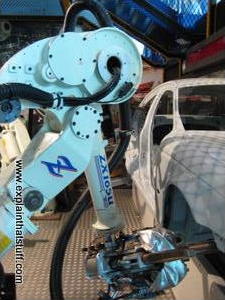
Industrial robot arm welding a Jaguar car
Photo: A modern car-welding robot at Think Tank, the museum of science in Birmingham, England.

Big in Japan: 1970s–1980s: Japan

American and European car firms dominated car production till the 1970s. Then Japanese upstarts such as Nissan, Honda, Mazda, and Toyota began to undercut them by exporting cheaply made cars to the West. For a time, countries like the United States and Britain fought off these imports. So the Japanese went further and began exporting their factoriesinstead. Honda became the first Japanese maker to open plants in the United States and Canada in the early 1980s.

Compete or cooperate? California, USA: 2000s–

Car makers used to compete; now they cooperate. In the world of "globalization", big companies and their brands operate beyond national borders. New cars are expensive to design so makers in different countries work together to reduce costs. A Renault made in France might use exactly the same chassis, engine, or bodywork as a Nissan made in Japan. Another example of globalization is when a car plant in one country builds vehicles for more than one maker. Toyota and General Motors jointly run a plant like this in Fremont, California making parts for Toyotas, Pontiacs, and Chevrolets.

Car-making memories: UK: 2000s–

Britain's car industry once employed over a million people and was the world's second-biggest producer after the United States. Today, the only big car plants left in Britain are run by Japanese firms and the once great names of British motoring—Jaguar, Rolls Royce, Bentley, and Aston Martin—are foreign-owned too.

Dream cars: China: 2000–

The Chinese are bicycle crazy: there are twice as many cycles in China as people in the United States. But all that could soon change. Car makers are eagerly turning their eyes to China, the world's fastest-growing car market, where sales are growing at 80 per cent a year. The country's biggest car maker, Shanghai Automotive, has already formed powerful alliances with big western firms including Fiat, General Motors, and Volkswagen.

Self-driving cars: California: 2000–

Who knows if we'll even be driving cars in the future? Companies like Google are now busily developing cars with onboard sensors that can navigate their way around the world while the people inside sit back and enjoy the view. Part robot, part computer, part old-fashioned automobile, these hybrid machines are likely to prove far safer and much more environmentally friendly than cars driven by careless, fallible humans.
Source: http://www.explainthatstuff.com/

History of Cars - Rise and Fall of Henry Ford

By the start of the 20th century, gasoline-engined cars were fast, reliable, and exciting. They were also stupidly expensive. In 1893, Karl Benz's simple, Viktoria car had a price tag of £9000 (about £50,000 today) and hardly anyone could afford one—he sold just 45. Car makers stuck with big, expensive cars, so customers stuck with their horses and carts. Then a bold American engineer called Henry Ford (1863-1947) came along and decided things had to be different.
"It was not at all my idea to make cars in any such petty fashion"—Henry Ford, My Life and Work, 1922.

The rise of Henry Ford

A steam traction engine in a museum
Ford was no scientist, but he'd been repairing watches and tinkering with machines since he was a boy. Never afraid of rolling up his sleeves, he loved machinery and understood it instinctively. His first car was little more than a four-wheel motorbike that he called the Quadricycle. When he took it on the streets of Detroit in 1896, horses bolted in all directions.
Photo: Henry Ford was inspired to build his first car after he saw a steam-powered tractor (traction engine) like this one. He realized straight away that engine-powered vehicles were the future.
Ford must have been delighted: he had no time for horses. Aged 14, he'd been thrown from the saddle of a colt, caught his foot in the stirrups, and dragged home along the ground. A few years later, he'd been seriously injured when his bolting horse and cart tried to smash through a fence. Now was the time to settle those scores.
Ford loved machines and hated horses, so he hatched a simple plan: he'd make the simplest possible "horseless carriage" and he'd make it in such enormous quantities, in only one color, that he could sell it cheaply to a huge number of people. It took him 12 years to get things right. In fact, he made eight different models (named A, B, C, F, N, R, S, and K) before he finally came up with a winner, the Model T, launched in 1908—a car everyone could afford. Around 15 million Model T Fords were eventually sold and a delighted (and very rich) Henry Ford scribbled in his notebook: "The horse is DONE".

The Assembly Line

Normally things get more expensive over time—but Ford's pint-sized miracle car, the Model T, dropped in price from $850 when it was launched in 1908 to just $260 in 1925. The secret was mass-production: making the car from simple, easy-to-fit parts in huge quantities. Other car makers used small groups of mechanics to build entire cars very slowly. By 1913, Ford was building cars at his new Highland Park factory in a completely different way using a moving "assembly line". Model Ts were gradually assembled on a conveyor that inched past a series of workers. Each mechanic was trained to do only one job and worked briefly on each car as it passed by. Then the vehicle moved on, someone else did another bit, and the whole car magically came together. The first year Ford used his assembly line, production of the Model T leaped from 82,000 to 189,000. By 1923, Ford's giant River Rouge factory was making 2 million cars a year.

The fall of Henry Ford

Henry Ford, Library of Congress
Photo: Henry Ford in later life. Photo by courtesy of US Library of Congress.
Henry Ford was a big success and a people's hero: no-one did more to put cars within reach of ordinary people. But he made big mistakes too, probably because he was a mess of contradictions.
Stuck in the past? Ford looked to the future—he grew soybeans to make plastic parts for cars and experimented withbiofuels years before almost anyone else. He famously wrote "History is more or less bunk". But, as he grew older, he set up his own museum, packed it full of nostalgic exhibits, and spent increasing amounts of time there daydreaming of a lost era. He even had visitors driven round on horses and carts.
Nostalgic? His assembly-line methods were widely copied and quickly transformed the United States from a clean and green farm-based nation into a dirty, smoky factory-based one. Yet the more industrialized things became, the more Ford yearned for the rural world he was helping to destroy.
Stubborn? The Model-T Ford was a huge success, but Ford refused to update it: "There is a tendency to keep monkeying with styles and to spoil a good thing by changing it." But other car makers began introducing a new model every year and the Ford Motor Company lost its lead. In 1927, Ford grudgingly abandoned the Model-T and closed down his factories for six months while they converted to making new models.
Arrogant? Ford had strong opinions and never shrank from expressing them. He ran for the US senate, but lost, and even seriously thought of standing for President. Though a brilliant mechanic, he had no qualifications to speak about world affairs.
Racist? Ford bought a newspaper and got into big trouble writing offensive articles about Jewish people. But he was one of the first industrialists to employ black people and treat them fairly.
Pacifist? When World War I broke out, this committed pacifist hired a huge ocean liner and sailed it round the world trying to make peace—earning nothing but ridicule. But during World War II, he turned his factory over to making thousands of bombers.

Spent Force

Ford built his company up from nothing and was determined to keep control. Despite making his son Edsel president in 1919, Ford still made all the big decisions. He belittled Edsel and cruelly undermined his authority. Once, when Edsel ordered new coal ovens for the steel plant at River Rouge, Ford waited till they'd been built before ordering them to be demolished. Though Ford humiliated Edsel, he was devastated when his son died from cancer in 1943, aged only 49. The sparkle vanished from his eyes and he hurtled towards senility. He briefly became president of the Ford Motor Company once more, but couldn't remember what he was supposed to be doing or why. By now, Ford was unquestionably the world's greatest industrialist: he'd made a personal fortune of over $1 billion. But he was deteriorating into what his doctor described as "a pleasant vegetable" and died after a massive stroke in 1947, aged 83.
Source: http://www.explainthatstuff.com/

History of Cars - Early Times

Cars are amazing! And one of the most amazing things about them is that no-one invented them—no single person, that is. There was no scribbling on the back of an envelope, no lightning flash of inspiration, and no-one ran down the street crying "Eureka". All the different parts—the engine, the wheels, the gears, and all the fiddly bits like the windscreen wipers—somehow came together, very gradually, over a period of about five and a half thousand years. How did it happen? Let's take a closer look!

A beige Model Y Ford from 1935.

Beasts of burden
t all began with the horse. Or the camel. Or perhaps even the dog. No-one really knows which animal prehistoric humans picked on first. People tended to stay put, living more locally than they do now. If they needed to move things about, they had to float them down rivers or drag them by sledge. All that started to change when humans realized the animals around them had raw power they could tap and tame. These "beasts of burden" were the first engines.
By about 5000BCE, there were sledges and there were animal "engines"—so the obvious thing to do was hitch them together. The Native Americans were masters at this. They invented the travois: a strong, A-shaped wooden frame, sometimes covered with animal skin, that a horse could drag behind it like a cart without wheels. First used thousands of years ago, the travois was still scraping along well into the 19th century.
The next big step was to add wheels and turn sledges into carts. The wheel, which first appeared around 3500 BCE, was one of the last great inventions of prehistoric times. No-one knows exactly how wheels were invented. A group of prehistoric people may have been rolling a heavy load along on tree trunks one day when they suddenly realized they could chop the logs like salami and make the slices into wheels. However it was invented, the wheel was a massive advance: it meant people and animals could pull heavier loads further and faster.
Huge and heavy, the first solid wheels were difficult to carve and more square than round. When someone had the bright idea of building lighter, rounder wheels from separate wooden spokes, lumbering carts became swift, sleek chariots. The ancient Egyptians, Greeks, and Romans all used chariots to expand their empires. They were a bit like horse-drawn tanks.

Chariots of fire


The next major development came in 1712 when "the very ingenious Mr Thomas Newcomen" (as his friends called him) built a massive machine for pumping rainwater out of coal mines. It was based around a huge 2-m (7-ft) high metal cylinder with a piston inside that could move up and down like the plunger in abicycle pump.
Every so often, steam from a boiler (a sort of gigantic coal-fired kettle) squirted into the space in the cylinder underneath the piston. Then cold water was squirted in to make the steam condense, creating a partial vacuum directly under the piston. Since the air pressure in the space above the piston was now greater than that in the space beneath it, the piston moved down. When the vacuum was released, the piston rose back up again. The rising and falling piston operated a pump that slowly sucked the water from the mine.
Machines like this were originally called fire engines—they were, after all, powered by burning coal—though they soon became known as steam engines when people realized that controlling steam was the key to making them work more efficiently. One of those people was a Scotsman named James Watt (1736–1819). In 1764, Watt redesigned Newcomen's engine so it was both a fraction the size and more powerful. Where Newcomen's piston had simply tipped a beam up and down, Watt's turned wheels and gears. Large Watt engines soon found their way into factories, where they became the powerhouse of the Industrial Revolution and people did away with horses for operating pumps and other machines. Coal seemed to be the fuel of the future.
Steam engines were still too big and heavy to use in vehicles, but that didn't stop people trying. In 1769, Frenchman Nicholas Joseph Cugnot (1725–1804) used steam-engine technology to make a lumbering, three-wheeled tractor for pulling heavy army cannons. Many people consider this the world's first car, but it was incredibly primitive by today's standards. With a top speed of just 5 km/h (3mph), you would have thought it posed little danger. But the "fardier à vapeur" (steam wagon) was heavy and hard to steer and, just two years later, the first ever car had the first ever car crash when Cugnot rammed it through a brick wall. He was given a speeding ticket and thrown in jail.
Restored steam locomotive engine in Swanage
Steam engines were soon finding their way into other heavy vehicles. In the early 1800s, Cornishman Richard Trevithick (1771–1833) started building steam carriages with wobbly 3-m (10-ft) diameter wheels. Around this time, Trevithick's American counterpart Oliver Evans (1755–1819) built an ambitious steam-powered river digger called the Oruktor Amphibolos that could drive on either land or water. Belching fire and smoke like a dragon, it caused a sensation as it chugged down the Philadelphia streets in 1804.
Photo: Steam engines were too large and cumbersome to power cars to begin with. This one is a newly rebuilt steam locomotive working on the Swanage Railway, England.
Both Trevithick and Evans ultimately switched their attention to making steam trains, but another Cornish inventor, Goldsworthy Gurney (1793–1875), was convinced the idea of steam road vehicles still had legs. Quite literally. He designed an early steam carriage that would gallop along on rickety pins, just like a horse. When Gurney realized wheels could do the job much better, he built impressive steam buses and ran a service between London and Bath. Ultimately he was driven out of business by horse-powered stage coaches, which were faster and cheaper. John Scott Russell (1808–1882) also had to close a promising steam-coach business when one of his buses exploded on 29 July 1834, killing four passengers. It was the world's first fatal car accident. Horses everywhere breathed a huge sigh of relief: they'd be around for many years yet. Or so they thought, until a clever bunch of scientists showed up.

Also visit History of Cars - Rise and Fall of Henry Ford and History of Cars - Car Planet

Monday, June 10, 2013

2014 Range Rover Blasts through Pikes Peak

2014 Range Rover Blasts through Pikes Peak
The new Range Rover Sport is not only a good off-roader, it's also wicked fast as it just set a new Pike's Peak record.
While some may have been concerned that Land Rover has been giving up some of its heralded off-road mojo lately in favor of making its models more luxurious, perhaps it’s time to put some of those fears to rest - at least in the speed department. The UK-based automaker has just announced that its 2014 Range Rover Sport has just set a new record at Pikes Peak, setting a new hill climb record time for a production SUV of 12 minutes and 35.61 seconds.
2014 Range Rover Blasts through Pikes Peak
Traveling at an average speed of 59.17 mph, the Range Rover Sport completed the 12.42 mile-long course faster than other standard production SUV. The Pikes Peak course itself is composed of 156 corners as it ascends beyond the treeline from 9,390 feet above sea level to 14,110 feet.
http://www.youtube.com/watch?feature=player_embedded&v=WhHFhVrs9BM
That altitude is so high that the air contains only 58 percent of the oxygen it does at sea level which diminishes engine performance. Additionally, driver Paul Dallenbach had to deal with the effects of what less oxygen does to one’s physical and mental performance, a major factor when considering how dangerous the Pikes Peak course is. The Range Rover Sport itself is equipped with a 5.0-liter supercharged V8 that pumps out 510 horsepower and the only modification allowed for Pikes Peak was the fitment of a roll cage and harness seatbelts to meet safety requirements. 
2014 Range Rover Blasts through Pikes Peak2014 Range Rover Blasts through Pikes Peak2014 Range Rover Blasts through Pikes Peak2014 Range Rover Blasts through Pikes Peak2014 Range Rover Blasts through Pikes Peak

Camaro ZL1 is Not Environmentally Friendly Today

Camaro ZL1 is Not Environmentally Friendly Today
Trying to save the planet? Don't expect that to happen on National Donut Day as this Camaro ZL1 burns plenty of fuel.
National Donut Day is something to celebrate with plenty of smoke, burnt rubber and wasted fuel. There’s simply no other way to do so and hopping behind the wheel of a Chevy Camaro ZL1 is a good start to making all three of those things happen. Instead of hitting the drag strip, just take that ZL1 to some empty parking lot and spin it around. With its 6.2-liter V8 producing 580 horsepower and 556 lb-ft torque paired up with a six-speed manual, the ZL1 is one of the best production cars in the world today for doing donuts.
Chevy is aware of this and marked the yearly occasion by releasing this video of a Camaro ZL1 in action. Damn, it sounds absolutely wonderful.
http://www.youtube.com/watch?feature=player_embedded&v=woYGwW2UB34
Camaro ZL1 is Not Environmentally Friendly TodayCamaro ZL1 is Not Environmentally Friendly Today


696 HP 'Draguar' is No Ordinary Jaguar

696 HP 'Draguar' is No Ordinary Jaguar
A 1974 Jaguar XJ12 is given a new lease on life as the crew at Hot Rod magazine prepare to give it a new long block V8.
The guys over at Hot Rod magazine have been working on an interesting project as of late. Some time ago they bought a 1974 Jaguar XJ12 with a Chevy small-block V8 under the hood for just $1,000. They installed a supercharger and when they took the car to a drag race, sure enough, the engine overheated. But they’re not giving up on the car that easily. Host Mike Finnegan ordered a brand-new 383 long block engine that can safely produce 650 horsepower with 91 octane fuel.
Thing is, Finnegan wouldn’t be a true hot rod enthusiast if he didn’t crank things up a notch or three, so he added 118 octane race fuel and upped the boost to 15 psi in order to make 700 hp.
To watch the video click here.
696 HP 'Draguar' is No Ordinary Jaguar
696 HP 'Draguar' is No Ordinary Jaguar696 HP 'Draguar' is No Ordinary Jaguar

Porsche 911 Gets Some Love with Car Porn Racing

Porsche 911 Gets Some Love with Car Porn Racing
Tuners in the Philippines may not be up to date on new music, and down coconuts instead of cheeseburgers. They no doubt work their tails off and can tune a Porsche as good as any.
Tuning may arguably have its earliest origins based in Japan, but it’s rare that we come across an interesting tuning project from the Philippines. In addition, most tuning stories that come across our desk do not come with video journals attached. Rauh Welt Begriff Manilla (RWB) is trying to get on the map with their project "Victoria", upgrading a Porsche 911. This tuner, that originally started from Japan and has recently expanded to the US, states that RWB emphasizes Japanese and European tuning elements.
Porsche 911 Gets Some Love with Car Porn Racing
Their Facebook page is growing a nice following for the project as well and the video log 
features an 80’s electron soundtrack that would make Herbie Hancock proud. It also demonstrates the hard work it takes, even with a break for coconuts, to get a tuning project out the door.
Porsche 911 Gets Some Love with Car Porn Racing
Watch the video here.

These Ponies are Rare, Exotic Creatures in Germany

These Ponies are Rare, Exotic Creatures in Germany
Germans may not love all things US (Wal-Mart left in 2006), but they sure love themselves some American Muscle

For a country that has given our citizens hot dogs, excuse me Frankfurters, and on top of that, some of the greatest mechanical engineering and design the United States has ever known, we decided to return the favor. Well at least for one event that recently went down in Germany. Owners and enthusiasts nationwide gathered to appreciate some good old American Muscle on display, replete with US and Confederate flags.
With a lineup of Mustangs, Camaros, Chargers, Vettes, and other favorites, the Europeans are likely stoked that they don't have to leave Bavaria for a taste of the States. Likewise for Americans its nice to see some respect for American ingenuity. Even though the pics look like they could be anywhere USA, It can't be hard to imagine how good the franks and beer tasted at this Deutschland tailgate extravaganza.
These Ponies are Rare, Exotic Creatures in GermanyThese Ponies are Rare, Exotic Creatures in GermanyThese Ponies are Rare, Exotic Creatures in GermanyThese Ponies are Rare, Exotic Creatures in GermanyThese Ponies are Rare, Exotic Creatures in GermanyThese Ponies are Rare, Exotic Creatures in GermanyThese Ponies are Rare, Exotic Creatures in GermanyThese Ponies are Rare, Exotic Creatures in GermanyThese Ponies are Rare, Exotic Creatures in GermanyThese Ponies are Rare, Exotic Creatures in GermanyThese Ponies are Rare, Exotic Creatures in Germany
These Ponies are Rare, Exotic Creatures in Germany

Friday, April 19, 2013

Rolls-Royce Makes a Pink Ghost


Rolls-Royce has unveiled a special version of its extended-wheelbase Ghost, called FAB1, with the hopes of helping to raise more than one million pounds (roughly $1.5 million) for a UK charity named Breast Cancer Care. Over the next year, the FAB1 Million Project will see this pink Ghost used to raise money by renting it out for special events and occasions with all of the proceeds going to the charity.

More than just a pretty pink paint job, though, this Ghost demonstrates some of the bespoke options you can order from Rolls-Royce, including pink carpeting, pink leather, pink center caps and even a pink umbrella tucked into the door.
ROLLS-ROYCE MOTOR CARS PROVIDES GHOST EXTENDED WHEELBASE TO FAB1 MILLION PROJECT IN SUPPORT OF BREAST CANCER CARE

Rolls-Royce Motor Cars proudly presents FAB1, a Rolls-Royce Ghost Extended Wheelbase set to support FAB1 Million and Breast Cancer Care.

Headed by Chris Evans, the FAB1 Million project is set to raise £1 million for Breast Cancer Care through making this bespoke Ghost available to hire over the next twelve months. This extraordinary car will make appearances at exclusive events as well as being available for hire for any special day, with all proceeds directly benefiting Breast Cancer Care.

In support of this exciting project and very worthy cause, the Rolls-Royce Bespoke team has prepared a very special motor car, combining numerous exclusive bespoke elements, from pink accented umbrellas, to hand-embroidered headrests featuring the Breast Cancer Care pink ribbon motif. Further enhancements include unique 'FAB1' treadplates and a Blushing Pink and Crème Light interior leather scheme. An uplit Spirit of Ecstasy adorns the silver satin bonnet.

In addition to providing a superior ride experience and ample legroom, the passenger experience of this exceptional Ghost Extended Wheelbase is enhanced with hand veneered picnic tables, 9.2 inch LCD screens and a champagne coolbox. Passengers will be able to relax with a chilled glass of champagne, indulge in a concerto, courtesy of a 10-channel amplifier and 16 speakers delivering 600 Watts of surround sound, or simply sink into sumptuous leather seats and lambswool footmats, relaxing into luxurious silence as they journey to their destination.

"When I received the call from Chris Evans to support FAB1 Million, we immediately sprang into action," said Jolyon Nash, Sales and Marketing Director. "It's taken countless hours to create such a special car but every minute spent is absolutely worth it for such a valuable cause. We wish the project every success."

The project is set to launch on Thursday 18 April with a star-studded point to point drive in FAB1 from Land's End to John O'Groats.

Hyundai Envisions an Egg Car


Engineers from the Korean automaker have created their vision of future and eco-friendly transportation. And it looks like an egg. This is what we may all possibly be driving in the next 20 to 30 years. Yes, the thought bothers us as well, but this isn’t the first time we’ve seen a major automaker toy around with the idea of building a car shaped like an egg. Now its Hyundai’s turn to give us nightmares regarding one of its visions of the future transportation. This new single-person prototype, called the E4U Egg Car (seriously), a prototype that weighs 176 lbs and has a maximum speed of only 15 mph.
Hyundai Envisions an Egg Car
The 4 Es stand for Egg, Evolution, Electricity and Eco-friendliness. Created by company engineers for the IDEA festival, the project is a design study on the future of mobility. The E4U is powered by four electric motors and propellers which give it the ability to hover above ground. The driver can even "talk" to the car via a wireless head set to tell it to switch the seating position from that of a car into a bike. Along with the egg car, Hyundai also debuted a multi-rotor flying car, a spare-tire electric bike, a portable transforming car, a five-jointed car, a road car/bike and a wind bike.Hyundai Envisions an Egg CarHyundai Envisions an Egg CarHyundai Envisions an Egg CarHyundai Envisions an Egg CarHyundai Envisions an Egg CarHyundai Envisions an Egg Car

Expensive Failures: Bugatti EB110

Expensive Failures: Bugatti EB110
Impressive as it was, the EB110 was done in by poor planning and bad timing.
You’ve really got to love the EB110, and your love for it should not be diminished by the fact that it was a flop. The fact is that there were several different factors which led to the downfall of this particular incarnation of Bugatti, but the quality of the car itself was never an issue. For the time, the car was a high-tech wonder, and produced performance figures which are still quite respectable 20 years later. But it still went under. Still, few marques in history carry with them the sort of gravitas that is associated with Bugatti.
After the company went bust following the difficulty of resuming operations after WWI and the death of Ettore Bugatti in 1947, there were several attempts to revive the brand. The first couple failed before even getting off the ground, and the company was absorbed by its own aircraft division, and then bigger aircraft companies during the Sixties. But in 1987, Romano Artioli attempted a full-on revival of the brand, complete with the sort of world-beating models that had made the brand what it was in the first place. The plans for the first car came in 1989, from designers Paulo Stanzani and Marcello Gandini.

You might recognize Gandini’s name from the article on the Cizeta V16T, or perhaps from his having designed the Lamborghini Miura, Countach and the original version of the Diablo. A new state-of-the-art factory was built in Campogalliano, Italy, to build the car, and if it isn’t already obvious, this was to be a much more Italian-influenced incarnation of Bugatti. But that’s fine, there are obviously plenty of amazing cars to come from Italy. And although he was a naturalized French citizen, Ettore Bugatti himself was born in Milan. The car adopted his initials EB and coupled them with the number 110 in reference to the 110th anniversary of Ettore’s birth.Expensive Failures: Bugatti EB110
Expensive Failures: Bugatti EB110Production would begin in 1991, and the completed product was a technological marvel. The body was built by Aerospatiale, a French airplane manufacturer, and was made of carbon fiber. There was a speed-sensitive raising rear wing as well as all-wheel-drive. Some have seen the scissor doors as a blatant Lamborghini rip-off, but the car was designed by the man who invented scissor doors, and could be argued to have more right to them than any post-Gandini Lambo. The engine was a 3.5-liter quad-turbo 12 which produced 553 horsepower. The later EB110 SS would push that figure to 603 horsepower while simultaneously coming in slightly lighter.
The EB110 could hit 62 mph in 4.2 seconds and a top speed of 213 mph, while the SS could do a 3.2-second 0-62 and a 216 mph top speed. We’re therefore talking about a pretty impressive car for 1991, so what went wrong? Well, there were a couple of problems. One was a recession that hit North America and Europe right at about the time the EB110 debuted. The $350,000 price tag (about $580,000 in today's money) was therefore not ideal. But the company was also sinking money into a sedan project - appropriately enough called the EB112, since it kicked off in 1993.Expensive Failures: Bugatti EB110Lastly, Artioli decided to buy up Lotus from GM to add to this expanding empire. But without EB110 sales able to keep pace with the money being spent on new development and acquisitions, Bugatti went bankrupt in 1995. In the end, just 139 units were produced, making the Veyron seem downright common by comparison. What Bugatti really needed, and ultimately got, was the backing of a huge automaker to help with development costs and keep market fluctuations from having such a devastating effect on its bottom line. The EB110 should have been a winning formula, but the timing just wasn’t right.Expensive Failures: Bugatti EB110Expensive Failures: Bugatti EB110Expensive Failures: Bugatti EB110